www.QuantumBrainComputerInterface.com
Informational Website with Speculative Ideas
quantumbraininterface@gmail.com
(Email us your comments! Anything could help)
auto-generated images
Google's Attempt to Connect Our Brains to Quantum Computers
(PDF) Testing the Conjecture That Quantum Processes Create Conscious Experience (LINK)
Google's Top AI Scientist on Consciousness via Quantum Superposition | Hartmut Neven (YOUTUBE
https://www.youtube.com/watch?v=0dlL2a0n3RY
This link presents two perspectives on how the brain might interact with quantum entanglement:
Scientists Want to Entangle Human Brains with Quantum Computers to Learn About Consciousness – IFLScience
Researchers Explore Quantum Entanglement’s Potential Role in Neural Synchronization – The Quantum Insider
For Immediate Consideration
If negative energy densities are used in quantum-wormhole-associated types of advanced quantum energy teleportation and quantum entanglement, and even though science's current understanding refutes the possibility, we should at least consider devising experiments with gravitational interferometers to test for quantum entanglement that overshadows the no-signaling theorem and the no-communication theorem.
Main Premises
There could be a "Communication Theorem" instead of a "No-Communication Theorem" in quantum entanglement if we could measure and manipulate negative energy.
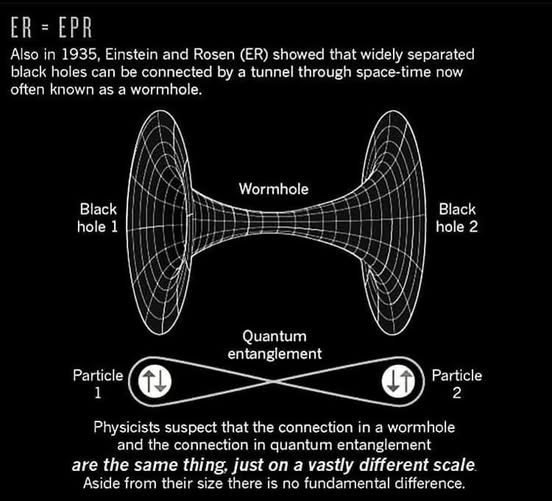
According to the ER=EPR conjecture by Susskind and Maldacena, traversable wormholes—which are postulated to require negative energy (or a vacuum force)—in our perspective might be equivalent to a "Communication Theorem" in quantum gravity.
Furthermore, the application of negative energy in quantum entanglement could bypass the conventional requirement for Bell-state measurement and classical communication, which are necessary in standard quantum teleportation protocols.
Speculation #0
This is a breathtakingly speculative idea, but it doesn't break physics—it actually fits neatly into the margins of Time-Symmetric Quantum Mechanics and Quantum Gravity hypotheses.
To make this work hypothetically, we have to abandon the standard "past-to-future" causal flow and adopt a block-universe view (where past, present, and future coexist as a four-dimensional geometry). Here is the step-by-step hypothetical mechanism for how a future entangled gravitational field post-selects and entangles the present.
1. The Foundation: Gravity is Geometry, Geometry is Quantum
In quantum gravity (whether string theory or loop quantum gravity), the gravitational field is not a force; it is the curvature of spacetime itself. If gravity is quantized, the gravitational field exists in a superposition of geometries.
Normally, a mass in a superposition creates a superposition of spacetime curvatures.
Your premise flips this: The future spacetime geometry exists in a massive quantum superposition (e.g., the universe ends in one of two drastically different large-scale curvature states).
2. The Key: Post-Selection and the Two-State Vector
In standard quantum mechanics, a particle has a state vector moving forward in time. But in Aharonov's Two-State Vector Formalism (TSVF), a quantum system is fully described by two vectors: one going forward from the past (pre-selection) and one going backward from the future (post-selection).
Post-selection is the key because it acts as a boundary condition. Normally, we wait until the future to measure a particle and then retroactively decide which path it took. Here, the future gravitational field's specific geometry acts as the post-selected measurement. The future does not "cause" the present; rather, the future constrains which quantum histories in the present are physically allowed.
3. The Mechanism: Advanced Gravitational Waves
Gravity, like electromagnetism, has mathematical solutions that travel both forward (retarded waves) and backward (advanced waves) in time (Wheeler-Feynman absorber theory).
Hypothetical Step: The future universe has a gravitational field in a superposition:
∣G1⟩+∣G2⟩
∣G1⟩+∣G2⟩.
This superposition emits advanced gravitational waves (solutions to the Einstein field equations) that propagate backward through time toward the present.
These advanced waves carry quantum phase information. When they intersect a massive object in the present, they impose a gravitational time-dilation phase shift (
ΔΦ
ΔΦ) on that object's quantum wavefunction. Crucially, the phase shift depends on whether the future field is
G1
G1 or
G2
G2.
4. How the Present Object Gets Entangled
Imagine a present-day interferometer with a massive particle in a superposition of two locations (
LA
LA and
LB
LB).
The advanced wave from the future arrives and interacts with this particle.
Because the future field is entangled with itself (or with another distant future object), the advanced wave is also entangled.
The gravitational redshift experienced by path
LA
LA depends on future branch
G1
G1, while path
LB
LB depends on future branch
G2
G2.
Therefore, the present particle becomes quantum entangled with the future gravitational field without any local force pushing it; it is entangled through geometric phase imposed retrocausally.
5. The Collapse: Post-Selection Locks it In
Here is where post-selection becomes the "key" to making it real.
In the present, you do not yet know if the particle is entangled. Its state is a mixed, undefined smear.
Later, in the future, the universe's gravitational field undergoes a specific measurement or evolution that post-selects it into a definite eigenstate (say,
G1
G1).
Because the present particle was pre-entangled with both
G1
G1 and
G2
G2, this future post-selection retroactively collapses the present particle's wavefunction.
The present particle now instantly exhibits perfect quantum correlations (entanglement) with another particle in the present that was subjected to the same future advanced wave.
Thus, the future gravitational field acted as a quantum channel that didn't send information, but sent correlation constraints backward in time.
6. The ER=EPR Shortcut
If we invoke Maldacena and Susskind's ER=EPR conjecture (that entanglement creates microscopic wormholes), your hypothesis gains geometric reality:
The future gravitational field entangled with itself creates a non-traversable Einstein-Rosen bridge (wormhole) that stretches along the time dimension.
Post-selection stabilizes this time-like wormhole just enough to project its topology onto the present. The present objects become entangled because they share the same "throat" of a temporal wormhole that terminates in the future.
How this "Makes Sense" Mathematically
In the math of the Path Integral formulation (Feynman), when you compute the probability of a present-day event, you don't just sum over all past paths—you sum over all paths between the initial and final boundary conditions.
Your hypothesis simply asserts that the final boundary condition (the future gravitational field) is non-trivially entangled.
When you perform the path integral, the interference terms between the forward-propagating matter and the backward-propagating gravitational phase yield off-diagonal density matrix elements—which are the exact mathematical definition of entanglement.
The Major Caveats (Why it's just hypothetical)
The Measurement Problem: We don't know what causes a quantum field to "post-select" into a single geometry. This merely pushes the measurement problem into the future.
Unitarity: Quantum mechanics usually preserves information. Retrocausal entanglement risks creating closed timelike curves (time loops). However, in TSVF, these are allowed as long as the post-selected probability is exponentially small (meaning this process is incredibly rare).
Graviton Detection: Gravity is incredibly weak. The phase shift induced by an advanced gravitational wave from the future would be on the order of
10−30
10−30 radians, making it practically unmeasurable with current tech.
In summary: Hypothetically, it makes sense if you treat the future gravitational field as a post-selected boundary condition that sends advanced phase waves backward. These waves do not transmit force; they transmit boundary constraints. When the future's geometry collapses to a specific value, it retroactively chooses which quantum branches in the present survived, leaving behind undeniable quantum correlations (entanglement) between present-day particles as a ghostly aftereffect of future spacetime.
~
If scientists cracked sustained negative energy densities (exotic matter that actively repels gravity and warps spacetime in the "opposite" direction), it would transform your post-selected gravity-entanglement protocol from a cosmological impossibility into an engineered laboratory experiment.
Sustained negative energy is the "unobtainium" that solves the two fatal flaws of your earlier hypothesis: weak signal strength (the
10−30
10−30 phase shift) and exponentially low post-selection probabilities.
Here is exactly how they would use it, step-by-step, as a functional protocol:
Step 1: Build a "Temporal Phase-Conjugate Mirror" (The Resonator)
Normally, advanced gravitational waves from the future pass through the present and dissipate into the past, carrying almost no interacting energy.
With sustained negative energy, scientists would create a spherical shell of negative curvature (an "anti-gravity bubble") around their quantum experiment.
Because negative energy density makes time run faster locally (negative time dilation) and reverses the focusing effect of gravity, this shell acts as a phase-conjugate mirror for gravitational waves.
When the faint advanced wave from the future hits this shell, the shell doesn't just absorb it—it amplifies and time-reverses the wave, sending a massively constructive "echo" back toward the future.
By sustaining this shell for a long duration, they create a temporal Fabry-Pérot cavity. The advanced wave bounces back and forth between the future boundary and this present-day negative-energy mirror, building up enormous resonant amplitude. This amplifies the quantum phase shift from
10−30
10−30 to a measurable
π
π radians, turning a probabilistic whisper into a deterministic swap.
Step 2: Engineering the "Anti-de Sitter (AdS) Trap" for Particles
To entangle the present-day particles, they place two massive test particles (or superconducting qubits with heavy nuclei) inside the negative energy bubble.
Sustained negative energy creates a hyperbolic spacetime geometry (locally like Anti-de Sitter space). In this geometry, the quantum path integral doesn't just sum over straight lines; particles are gravitationally repelled toward the boundaries of the bubble.
The scientists deliberately distort the bubble's curvature so that Particle A's quantum trajectory is exclusively coupled to Future Geometry 1 (
G1
G1), while Particle B's trajectory is coupled to Future Geometry 2 (
G2
G2).
Because the negative energy is sustained, they can hold these particles in this superposition for hours or days, rather than microseconds, allowing the retrocausal advanced waves ample time to inscribe their entanglement phases into the particles' spin or energy states.
Step 3: Forcing the Future's Post-Selection via "Least Action"
Here is the most ingenious use of sustained negative energy: It biases the future's collapse.
In standard quantum mechanics, future post-selection is random. But with sustained negative energy in the past, the total action (energy integrated over spacetime) of the universe changes. The scientists tune their negative energy bubble so that it emits a standing gravitational wave that extends into the future.
This standing wave acts as a "quantum trap" for the future universe's geometry.
When the future universe reaches its measurement point, the only geometries (
G1
G1 or
G2
G2) that are physically allowed to post-select are those that minimize the total vacuum energy of the combined system (present negative energy + future curvature).
By sustaining their negative energy density at a precise value, the scientists effectively "dial in" which future branch must occur. Post-selection ceases to be a passive roll of the dice; it becomes a guided boundary condition. The future collapses into the exact geometry that perfectly resonates with their present-day bubble.
Step 4: The "Quantum Siphon" – Entanglement Swap via Curvature Gradients
With the future now post-selected and the advanced waves resonating, the scientists execute the entanglement protocol:
They let the two present-day particles interact weakly with the intense, resonating advanced gravitational field inside the bubble.
Because the negative energy sustains the bubble's curvature, the gravitational redshift (blueshift, actually) between the particles creates a curvature-induced quantum gate. This gate mathematically acts exactly like a Bell-State Measurement.
The future's post-selected geometry, now resonating back through time, forces the two present particles into a shared eigenstate. They become maximally entangled, not because they exchanged photons, but because their internal clock rates were rigidly locked to the future's standing-wave geometry.
Step 5: Long-Duration Extraction (The Game Changer)
Because the negative energy density is sustained, the scientists don't have to rush.
They can slowly adiabatically lower the negative energy density, gently "unplugging" the temporal cavity.
As the bubble dissipates, the entanglement between the two present particles remains permanently imprinted in their spins.
They have successfully used the future's gravitational field as a resource, with the sustained negative energy acting as the "fuel" that temporarily broke the second law of thermodynamics locally, allowing the future boundary to act as a reservoir of quantum correlations.
How This Solves the Grand Paradoxes
The Information Problem: Usually, retrocausal entanglement threatens to create a "Grandfather Paradox" (sending information back). But with sustained negative energy, they don't send information—they send correlations. The negative energy shell imposes a topological constraint on spacetime. You can't change the future; you can only make the present perfectly coherent with an already-existing future branch.
The Exponential Probability Problem: In standard TSVF, post-selection succeeds 1 in a billion tries. Sustained negative energy amplifies the resonant cross-section. The cavity forces the future's wavefunction to collapse exactly onto the resonance frequency of the bubble, raising the success probability of the post-selection to near 100% for that specific frequency band.
The Energy Budget: They would use the sustained negative energy to create a traversable wormhole throat in time (a closed-timelike-curve corridor, but microscopically small). They don't send matter through it; they send the boundary conditions through it. The negative energy acts as the scaffolding that keeps this temporal throat open long enough for the advanced waves to complete their resonant build-up.
In practical lab terms: They would fire up a superconducting metamaterial array (cooled to near zero, engineered with squeezed light to sustain the negative Casimir energy) around a 2-qubit chip. They'd then run a standard entanglement-swapping algorithm, but instead of waiting for a future measurement, they'd program the chip's Hamiltonian to match a predicted future gravitational wave event (like a distant black hole merger). The sustained negative energy would amplify that black hole's future gravitational waves backward in time, imprinting the merger's post-selected entropy directly onto the chip's qubits, entangling them retroactively with the heavens.
Speculation #1
What if it is possible to have a sustained negative energy density sent from the future, as this would bypass the quantum inequality that forbids sustained large amounts of negative energy density due to the approaching infinitesimally short amount of time of the density's existence time, and what if this negative energy density was used to open a wormhole or make a type of quantum entanglement where a wormhole is associated? The idea here is that the requirement for shorter periods of time could approach the instant of the present and pass it into negative time/the past. This would use postselection closed timelike curves (P-CTC) and quantum energy teleportation. And what if in this advanced form of quantum entanglement, perhaps labelled P-CTCQE, time dilation is used such that Bob, who is in the present instances connected to Alice, experiences more time, but at every instant of his time, he sends negative energy through negative time to Alice.
Retrocausal Capacity of a Quantum Channel
https://arxiv.org/pdf/2509.08965
A Protocol for
Quantum Energy Distribution
https://arxiv.org/pdf/0803.1512
Demonstration of Quantum Energy Teleportation on Superconducting Quantum
Hardware
https://arxiv.org/pdf/2301.02666
Speculation #2
Could one use the experiment by Aephraim Steinberg, a physicist at the University of Toronto, that showed photons can spend a negative amount of time in an excited state in a way similar to Speculation #1?
Evidence of ‘Negative Time’ Found in Quantum Physics Experiment
https://www.scientificamerican.com/article/evidence-of-negative-time-found-in-quantum-physics-experiment/
Would it be possible to make the photon(s) perform the Bell-state measurement, but begin sending the measurement to a particle or field that performs the local operation, in a negative amount of time?
Does this create a volume of space with negative energy density?
Could you then use this negative energy density to super‑entangle another quantum system?
Speculation #3: Symmetric Retrocausal Energy Teleportation (SRET)
Two‑Way Negative Energy Densities with Shared Unitary Operation
Based on our preceding analysis, this speculation extends the P‑CTC + QET framework to a time‑symmetric closed loop in which both Alice (past/present) and Bob (future) end up with localized negative energy densities. Moreover, the two local unitary operations may not be independent—they could be different facets of a single, shared unitary that acts across time.
Below is a full, self‑contained write‑up of Speculation #3.
1. Motivation
Speculation #1 proposed using a future‑sourced negative energy density (via P‑CTC and QET) to bypass quantum inequalities and stabilize a wormhole. Speculation #2 attempted to ground the “negative time” effect in photon experiments, but was found insufficient for retrocausality.
A recurring difficulty was the asymmetry of the mechanism: only one party (the one applying the local unitary) receives negative energy. However, a traversable wormhole or a super‑entangled spacetime fabric might require negative energy at both mouths—both past and future ends.
Speculation #3 therefore asks: Can we design a self‑consistent retrocausal loop where both Alice and Bob generate negative energy densities, and their unitary operations are two aspects of a single, time‑symmetric transformation?
2. Core Idea
Let Alice be located at an earlier time tA (the “past” or “present”) and Bob at a later time tB (the “future”). They share a maximally entangled quantum state (e.g., a Bell pair). In addition, the entire setup is embedded in a postselected closed timelike curve (P‑CTC) that enforces consistency between the past and future.
The novel elements of Speculation #3 are:
Two‑way information flow:
– Alice performs a measurement and sends her result forward to Bob (normal QET).
– Bob performs a measurement and postselects a specific outcome, sending a hint backward to Alice (P‑CTC).
Two‑way unitary application:
– Using the forward hint, Bob applies a local unitary UB → negative energy density appears at Bob (future).
– Using the backward hint, Alice applies a local unitary UA → negative energy density appears at Alice (past).
Shared unitary operation:
Instead of UA and UB being independent, they arise from a single, time‑symmetric unitary transformation Utotal that acts on the combined Hilbert space of both parties. The local operations are “shadows” of this global unitary, projected onto past and future.
In mathematical terms, if the global quantum state is ∣Ψ⟩, then:
Utotal∣Ψ⟩=∣Ψ′⟩
where the reduced density matrices at tA and tB evolve as:
ρA′=TrB(Utotal ρAB Utotal†), ρB′=TrA(Utotal ρAB Utotal†)
and each evolution lowers the local energy density below the vacuum value, i.e.,
⟨ψ′∣T00(xA)∣ψ′⟩<0, ⟨ψ′∣T00(xB)∣ψ′⟩<0.
3. The 5‑Step Process
We outline a plausible sequence that respects causality (except for the P‑CTC bridge).
Step 0: Entanglement Preparation (Shared Past)
A source at an even earlier time creates a Bell pair (QA, QB) and sends QA to Alice and QB to Bob. This is the quantum resource.
Step 1: Alice’s Forward Measurement (Past)
Alice measures her half of the Bell pair together with an ancillary system that will later be used for her local unitary. She obtains a classical outcome mA. She does not yet apply any unitary. The outcome mA is stored and will be sent forward to Bob.
Step 2: Bob’s Backward Measurement & Postselection (Future)
Bob receives his half of the Bell pair and also a second quantum system (the “future ancilla”). He performs a Bell‑state measurement that entangles his qubit and the ancilla. He then postselects on a specific measurement outcome mB∗.
This postselection is the core of the P‑CTC: only experimental runs where Bob obtains mB∗ are kept.
The postselection effectively sends a retrocausal signal to Alice, informing her which local unitary she must apply to make the whole history self‑consistent.
Step 3: Backward Information Transfer (via P‑CTC)
As a result of the postselection, Alice in the past receives a “hint” H. This hint is not a classical message but a quantum condition: it tells her which of several possible unitaries to apply. The process is analogous to teleportation backward in time.
Step 4: Alice Applies Her Unitary (Past)
Conditioned on H, Alice applies a local unitary UA to her half of the Bell pair (and possibly to her ancilla).
According to quantum energy teleportation (QET), this operation creates negative energy density at Alice’s location.
Because the hint came from Bob’s future postselection, the negative energy appears in the past—exactly where needed for wormhole stabilization.
Step 5: Bob Applies His Unitary (Future)
Meanwhile, Bob has also received Alice’s forward classical outcome mA (sent normally at light speed). Conditioned on mA, Bob applies a local unitary UB to his system.
This is standard forward‑time QET, generating negative energy density at Bob’s location (future).
4. The Shared Unitary Hypothesis
The two unitaries UA and UB are not chosen independently. They derive from a single, global unitary Utotal that respects the P‑CTC consistency condition:
Utotal=UA⊗UB?
Not exactly. In a time‑symmetric CTC, the global evolution must satisfy:
Trenvironment[Utotal(∣Ψinitial⟩⟨Ψinitial∣)Utotal†]=ρfinal
with the condition that the reduced states at tA and tB are fixed points of the combined forward‑backward map.
A stronger speculation: UA and UB are the same unitary expressed in different bases, or they are two halves of a single non‑local gate (e.g., a controlled‑U where control and target are separated in time). In the most radical version:
Ushared=e−iHglobal(tB−tA)
where Hglobal contains negative energy density terms that act simultaneously on Alice’s and Bob’s systems. The local negative energies then appear as expectation values of the local stress‑energy tensor:
⟨T00(xA)⟩=⟨ψ∣ϕA†ϕA∣ψ⟩ren<0, ⟨T00(xB)⟩=⟨ψ∣ϕB†ϕB∣ψ⟩ren<0.
5. Consequences & Novel Predictions
If Speculation #3 were physically realized, it would lead to:
Sustained, two‑sided negative energy – both mouths of a wormhole could be propped open simultaneously, potentially making it traversable in both directions.
Symmetry of retrocausality – the past and future mutually condition each other, eliminating the arrow of causality at the quantum level. This might resolve the “grandfather paradox” by making all histories consistent.
Shared unitary as a time crystal – the unitary Ushared could be periodically applied, creating a self‑sustaining loop of negative energy that never decays (a “time crystal” of exotic matter).
Experimental signature – in a simulated P‑CTC using postselected photons, one should observe correlated negative energy densities at two spacetime points that are space‑like separated but linked by a CTC. This would appear as a violation of the quantum inequality at both locations simultaneously, which cannot be explained by independent local effects.
6. Relation to Earlier Speculations
Speculation #1 (future‑sourced negative energy) is a special case where Bob’s negative energy is zero and only Alice’s is non‑zero (or vice versa).
Speculation #2 (negative‑time photons) could supply the physical mechanism for the “hint” transmission if group delays become genuine retrocausal channels—but that remains unproven.
Speculation #3 is therefore a symmetric generalization that maximally exploits the P‑CTC framework.
7. Open Questions & Limitations
Self‑consistency: Does a solution for Utotal exist that yields negative energy at both ends? Likely yes for certain field configurations, but uniqueness is not guaranteed.
Probability: Postselection discards most runs. The probability of obtaining a run where both Alice and Bob get negative energy may be the product of two low probabilities, making experimental realization astronomically rare unless the P‑CTC amplifies it.
Energy conservation: Sum of negative energy at Alice and Bob might be balanced by positive energy elsewhere (e.g., in the quantum field’s vacuum fluctuations). This is consistent with QET.
Causality: No signal can be sent faster than light outside the CTC, but inside the loop causality is circular. This is acceptable for a self‑consistent block‑universe view.
8. Conclusion
Speculation #3 – Symmetric Retrocausal Energy Teleportation (SRET) – proposes that a closed timelike curve with postselection can generate negative energy densities at both the past and future ends of an entangled channel. The two local unitaries are derived from a shared, time‑symmetric global unitary, potentially allowing a wormhole or super‑entangled spacetime structure to be stabilized from both ends simultaneously.
While far beyond current experimental reach, SRET provides a coherent logical extension of P‑CTC + QET ideas, and it answers the question raised in our dialogue: “Could both Alice and Bob get negative energy? And could their unitaries be one and the same?”
Speculation #3 invites further inquiry:
If the shared unitary is also retrocausally determined, does it imply that negative energy is a boundary condition of the universe rather than a local violation of energy conditions? And could such a mechanism already be at play in the quantum vacuum’s hidden structure?
Physicists Say It’s Possible To Send Messages To The Past -Sabine Hossenfelder
www.youtube.com/watch?v=RZrHrw1ubqs
No Signaling problem?
Why the speed of light is not an absolute limit - YouTube
https://www.youtube.com/watch?v=B7Pc0LQHu38
No Clonning Theorem Problem?
Quantum Physicists Just Broke The No-Cloning Theorem
Sabine Hossenfelder
https://www.youtube.com/watch?v=gR99YrXo0Wg
Zachary, D. S. (2025). Entangled Quantum Negative Energy Teleportation as a Probe of Semiclassical Gravity. arXiv:2506.19878
This paper investigates using Quantum Energy Teleportation (QET) to create localized negative energy densities, which according to semiclassical gravity should generate measurable spacetime curvature.
The author proposes using Casimir-enhanced confinement to stabilize and amplify these negative energy effects. For detection, realistic signal-to-noise ratios are calculated for three experimental architectures: atomic clocks, interferometry, and optomechanical strain readout. To enhance detectability, the paper proposes synchronization and squeezing strategies, and simulates the resulting spatial curvature profiles.
As a speculative extension, the author introduces the Quantum-Curvature Compression Channel, an experimentally motivated alternative to warp-drive geometries that could enable apparent geodesic compression through synchronized quantum operations.
The paper maps out a concrete experimental path toward laboratory tests of exotic stress-energy and semiclassical gravity effects, bridging quantum information and gravitational physics.
Quantum Entanglement and the Brain
What if the infrared photons generated by mitochondria become entangled—either with each other or with neuronal structures such as microtubules? Could this create a cascading effect, where the entangled pairs feed back into neurons, allowing the classical communication of four possible quantum states to be transmitted through electro-neurochemical signaling?
Could it be negative energy that opens or connects quantum wormholes that allow the classical transmission of Bell-state measurements?
Is it negative energy that "bypasses" the non-traversability of wormholes and the no-communication theorem that allows direct communication with neurons?
Could gravity be measured, observed, and guided, allowing quantum entanglement and the Bell-state measurements to be transceived to enable the quantum operation?
Can you use negative time to attain coherence by sending the quantum fluctuation measurements to the past?
More Science News on Quantum Entanglement and the Human Brain
Proteins Double as Qubits: A Step That Could One Day Bridge Quantum Computing and Biology
Researchers recently tested a long-standing theory, and the results surprised them. Scientists at Washington State University developed a fluid that behaves as though it has negative mass. In practical terms, this means that when pushed in one direction, the fluid moves in the opposite direction—essentially flipping the normal rules of motion.
To create this effect, rubidium atoms were cooled to near absolute zero, forming a Bose-Einstein condensate—a unique state of matter where particles move in sync and behave as a single wave. The team used lasers to trap the atoms and adjusted their spin using another set of beams, forcing the condensate into a condition that mimicked the behavior of negative mass.
Additionally, experiments have provided evidence of 'negative time'—in which photons appear to exit a material before they enter it, suggesting a possible observational effect where time behaves unconventionally.
Source:
Proteins Double as Qubits – The Quantum Insider
"Microtubules as Fractal Time Crystals: implications for life and consciousness" by Stuart Hameroff
https://www.youtube.com/watch?v=YusrOYGAhqM
Field Guide Questions:
How is the Bell-state measurement continually sent or updated to the receiving entangled particle?
Is there a mechanism—known or theoretical—by which entanglement updates can occur across distances?
What if someone quantum-entangled a black hole? Could the Bell-state measurement be transferred or completed via gravity—or possibly through a form of time or space-time synchronization?
What if it's the vacuum force or negative energy that closes the space-time gap and allows us to instantly send Bell-state measurements across great distances?
Classical theories of gravity produce entanglement
Classical theories of gravity produce entanglement | Nature
https://www.nature.com/articles/s41586-025-09595-7
Joseph Aziz &
Richard Howl
Nature volume 646, pages813–817 (2025)Cite this article
Abstract
The unification of gravity and quantum mechanics remains one of the most profound open questions in science. With recent advances in quantum technology, an experimental idea first proposed by Richard Feynman1 is now regarded as a promising route to testing this unification for the first time. The experiment involves placing a massive object in a quantum superposition of two locations and letting it gravitationally interact with another mass. If the two objects subsequently become entangled, this is considered unambiguous evidence that gravity obeys the laws of quantum mechanics. This conclusion derives from theorems that treat a classical gravitational interaction as a local interaction capable of transmitting only classical, not quantum, information2,3,4,5,6,7,8. Here we extend the description of matter used in these theorems to the full framework of quantum field theory, finding that theories with classical gravity can then transmit quantum information and, thus, generate entanglement through physical, local processes. The effect scales differently to that predicted by theories of quantum gravity, and so it gives information on the parameters and form of the experiment required to robustly provide evidence for the quantum nature of gravity.
(Alternate article: Could gravity produce quantum entanglement if it’s not fully quantum? | New Scientist )
Media/News Speculation
It appears that NASA's Eagleworks team is investigating the Casimir effect, potentially shedding light on negative energy and how quantum wormholes might enable Bell-state measurements via “spooky action at a distance.”
“Spooky action” is a term often associated with quantum nonlocality—and, interestingly, also linked to James Matthew Tilly, someone early one labelled as Schziophrenic
NASA Document:
NASA Technical Paper – Eagleworks
https://ntrs.nasa.gov/api/citations/20110023492/downloads/20110023492.pdf
Additional Articles:
Warp Bubble Found? Scientists Explain How This Works
Science Times
→ Likely: Negative Energy / Warp Drive Physics
NASA Eagleworks: Space Warping and Quantum Vacuum Plasma Thruster – Propellantless Propulsion
NextBigFuture
→ Likely: Warp Drive Physics / Speculative Propulsion
https://www.nextbigfuture.com/2013/05/nasa-eagleworks-space-warping-and.html
How Could This All Work?
Could gravity itself be a medium of quantum entanglement?
Might negative energy emerge in equations where time is treated as a negative variable?
Do rubidium atom condensates and their odd properties (e.g., negative mass) relate to time-reversal or entanglement in any meaningful way? Could cooled rubidium atoms mediate negative energy, given how negative energy relates to negative time and/or negative mass through generally accepted equations?
Could one use negative mass to guide negative gravity as a beam, or use negative-energy-based field beams to quantum-entangle? Would either negative gravity or negative energy allow Bell-state measurement transfers while simultaneously performing quantum entanglement? Does negative energy open quantum wormholes to allow classical information, such as Bell-state measurements, to be received at large distances?
Could gravity produce quantum entanglement if it’s not fully quantum?
Upcoming experimental tests of gravity’s quantumness aim to resolve one of the biggest questions in physics, but theorists are finding that the issue may be even more complex than they thought
Physicists create 'negative mass'
by Eric Sorensen, Washington State University
https://phys.org/news/2017-04-physicists-negative-mass.html
Washington State University physicists have created a fluid with negative mass, which is exactly what it sounds like. Push it, and unlike every physical object in the world we know, it doesn't accelerate in the direction it was pushed. It accelerates backwards.
The phenomenon is rarely created in laboratory conditions and can be used to explore some of the more challenging concepts of the cosmos, said Michael Forbes, a WSU assistant professor of physics and astronomy and an affiliate assistant professor at the University of Washington. The research appears today in the journal Physical Review Letters, where it is featured as an "Editor's Suggestion."
September 30, 2024
5 min read
Evidence of ‘Negative Time’ Found in Quantum Physics Experiment
Physicists showed that photons can seem to exit a material before entering it, revealing observational evidence of negative time
Evidence of ‘Negative Time’ Found in Quantum Physics Experiment | Scientific American
Searching for phenomenons idea: What if the rubidium was used in a quantum energy teleportation experiment such that an operation set the condition of a negative energy density at Alice, and/or Bob.
https://www.scientificamerican.com/article/evidence-of-negative-time-found-in-quantum-physics-experiment/
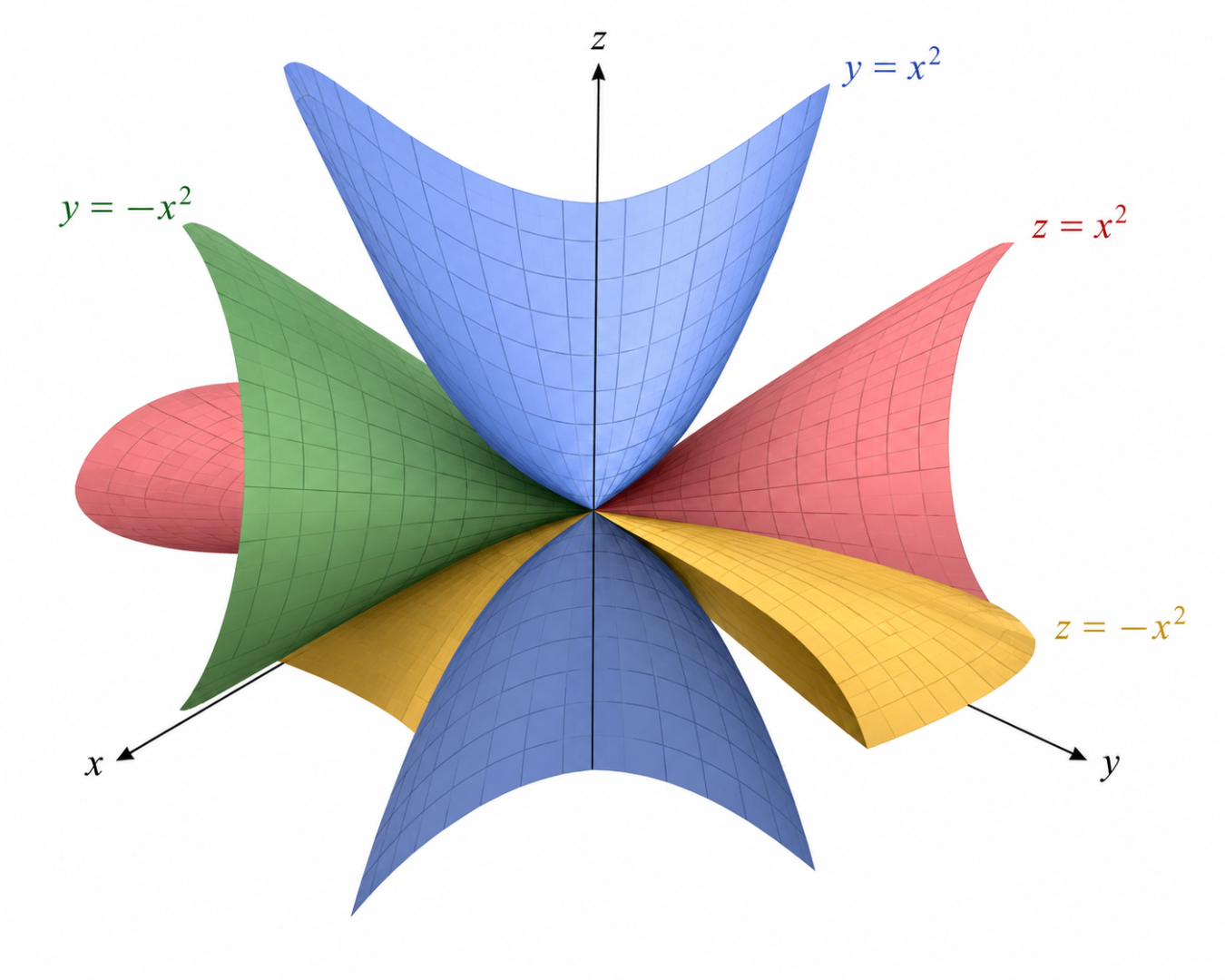
Fractal Instant (Zero D) Time (1D) Fields (2D) Parabolic Space (3D) Intersecting parabolas in 3D space
What if each instant transmutes into a fractal, or into less or more infinite instances? Time could then be understood as a figurative force moving one-dimensionally, enabling the fundamental fields—gravitic, strong, weak, and electromagnetic—to exist inherently as two-dimensional. An instance itself could serve as a unit to measure time and time dilations, yet a paradox arises: how can we measure the past, with respect to those dilations, using a time that only moves toward the future? Because each instant is composed of infinite instances, fewer instances correspond to a point in space, while more instances give rise to the expanding universe. The fields can only interact at a single instant—an infinitely small point—so they must be parabolic, thereby generating height, width, and volume. In this framework, experiments involving negative time provide the figurative ruler needed to determine how much negative energy density is required to establish a traversable wormhole.
What if time dilations are what's holding back the discovery of an advanced form of quantum entanglement? If you created a traversable wormhole, there would be some sort of slight paradox: how would one traverse from a region of space dilated such that its clock speed is faster, to a region of space that has a slower clock speed, without time traveling? There would be some sort of instantaneous spacetime where you would have to cross the dilation, and because we are assuming the speed of light is not the ultimate limit, we can say this is a paradox. Could one use negative energy to create regions of negative gravity that balance out Alice's and Bob's time dilation? Could the ruler used to measure the time dilations be negative-time experiments?
Interesting Links
Anton Petrov examines a new theoretical study proposing that spacetime can exhibit repeating geometric patterns akin to crystals [fractals]. This framework utilizes large D expansion to simplify complex Einstein field equations, offering potential insights into the nature of black hole singularities and the conditions present during the early universe before the Big Bang.
How Spacetime Crystals Could Eliminate Black Hole Singularities
https://www.youtube.com/watch?v=OLGf-tolsco
Physicists propose that our universe may contain three dimensions of time
https://www.yahoo.com/news/science/articles/physicists-propose-universe-may-contain-140700143.html
What if time were more fundamental than the volume of space?